Simply working in the yard, gardening, takes on a solemn grace when returning home from a long and trying absence. Delight taken in the rhythms of physical labor, the weary muscles. The morning after our homecoming from three years in Honduras, we pulled on the raggedy pants and threadbare T-shirts and unlocked the backyard shed. Having entrusted the yard’s upkeep to a friend’s teenage daughter, we nodded that trees, shrubs, bushes, and lawn offered some evidence of husbandry, but we felt eager to don the gloves and trim, yank, mend, uproot, clip, dig, deadhead, rake, and fill the green barrel ourselves.
After a morning with coffee reading Peter Bergen’s “The Longest War” about the troubling and fractious struggle of the United States and Al Qaeda, the larger struggle, it seems, of embattled civilizations, I drifted to the front yard. The previous owners had wisely planted drought-resistant, and so healthy looked the Japanese maple, the succulents, a swath of seaside daisy, needle grass, what may or may not be Toyon, Spanish lavender, and tall swaying palms. Rose bushes under the roof line were top-heavy but hardy. One morning my wife, Carrie, ventured out—she’d been working within on our new bathroom—and hacked and sawed her way through a number of invasive trees which lurk in numerous Santa Rosa neighborhoods and scatter thick carpets of foamy yellow blossoms in the fall. I took to cutting the branches, dragged them around to stack them for the barrel, and then cleared dead brush, twigs, and pale brown leaves.
Often I paused to stand dejectedly beneath our ample-leafed but nearly fruitless apple tree. A young guy sent out by AAA to replace the dead battery in our van, Merle, suggested, as we ran the engine to charge the new battery, that drought could have been the culprit, or perhaps by trimming too early I had “shocked” the poor tree, traumatic stress dampening any surge to bear fruit. Merle’s family own a 40-acre farm in Willets, an hour or so north, and his parents knew orchards, and although he suggested drought, he didn’t mention the late and lusty spring rains that could have slashed the delicate blossoms, but he seemed the kind of man who’d know that. Our neighbor, Doug, wandered over later that morning, and I congratulated him on his robust and lush garden: California poppies in a wild and swirling mass, fleshy lettuce, dozens upon dozens of yellow star blossoms hanging on dozens of tomato plants, verdant mint, vines of wine grape, wildflowers. Our patch under the apple tree looked dusty and barren apart from the sproutings of poppies flung on the wind from Doug’s garden, or drizzled across in the rains.
After consulting with Carrie to differentiate weeds from friendlies, I began digging with hand shovel into the unwanted roots of dandelion and thistle and grasses. The tiny yellow dandelion blossom prompted an inquiry into weeds, so uniformly despised for their thriving domination, but is there a more delightful word than dandelion? Why are weeds weeds? The common sense defines them as unwanted plants, unplanned and threatening to overtake the plants we want and cultivate. On his helpful webpage, Dwight D. Ligenfelter, Assistant Extension Agronomist at Penn State University, offers a few ideas: that weeds are plants not intentionally sown, plants out of place; and note the adjectives: competitive, pernicious, persistent, and “interfere negatively with human activity.” The official definition is a plant that is not valued where it is growing and is usually of vigorous growth; especially: one that tends to overgrow or choke out more desirable plants. You’ll notice the passive voice in these designations, but only because it’s quite obvious, as Protagoras of Abdera put it around 5th BCE, that man is the measure of all things. Only we determine what is a weed from what is not, nature doesn’t.
Interestingly, a lesser known definition of weeds is dress worn as a sign of mourning, proper attire for the widow of yesteryear. I doubt this almost completely, but take some imagined delight thinking that in conservative Muslim societies the women share a private cultural joke, wearing the black hijab to mourn their loss of freedom and equality.
Mr. Ligenfelter also shared Ralph Waldo Emerson’s insight that weeds are plants “whose virtues have not yet been discovered.” Through experience we know the characteristics of weeds, but our scholar at Penn state offers thorough “negative” virtues: abundant seed production; rapid population establishment; seed dormancy; long-term survival of buried seed; adaptation for spread; presence of vegetative reproductive structures; and ability to occupy sites disturbed by human activities. This last is telling: by disturbing nature, we invite weeds to lay claim to the land, and so we begin the never-ending battle of control and eradication.
Weeds as we deem them didn’t exist before agriculture. As Merrill and Ortiz put it in The Gardener’s Table, weeds were “simply invasive, fast-growing herbs that had a purpose in the grand scheme of things.” Indeed, weeds served the useful natural purpose of getting soils ready for planting. Table rasa land invites weeds, which die and provide organic compost to soils. From weeds propagating and dying, ground is prepared for perennials, shrubs, and then trees. “Essentially,” they continue, “your garden is a permanently disturbed area that serves as a haven for weeds.” Nature is balanced, harmony. And in the same way nothing in nature is inherently “bad”, so there are benefits to leaving some weeds to thrive: their deep-ranging roots open up the soil for air and water, summoning up subsoil nutrients; beneficial insects (bees, dragonflies, ladybugs) find shelter, food, and enriching liquid in weeds; they also keep the soil from eroding and blowing away, even keeping the soil moist. It seems we need a thorough knowledge and understanding of useful weeds to keep our gardens growing. Toward this end, Carrie and I constructed two 6x3x1 foot raised beds of redwood for golden zucchini, sage, Brandywine tomato, Sungold cherry tomato, tomatillo, French thyme, chili de arbol, and basil.
Our tortoise shell cat, Tigre, made the arduous journey with us from Honduras through airport security and under the seat in front of you in her collapsible carrier. In her first days in the new world she found dark secure caves of isolation to adjust, venturing out with tentative trust for meals and bathroom. After completing surveys around the house, she located prominent morning and late afternoon ribbons of sun to lounge and contemplate questions of natural theology and canned food. Small birds alighting on telephone wires issued lively and open intelligence reports as Tigre ventured out back to explore the foreign grass and shrubbery (she’d only known a walled-in driveway and potted plants in Honduras). We worried about the bird life, desired peace but hoped for an uneasy détente between avian and feline, and to this end attached a bell to Tigre’s collar. Of course, as actions can produce the desired as well as unintended consequences, the dangling declaration of Tigre’s presence for birds also alerted the dogs on all neighborly sides to possible issues of national security. Tigre’s stealth was compromised early on, and one afternoon she’d crossed the boundary and was chased by growling beasts—she escaped, and disappeared for hours in hiding—but this in turn produced the welcome outcome of keeping her generally within our backyard. Undeterred, she was quick to exploit a loophole by swiftly mounting the fence to conduct reconnaissance (she cocked an ear at our warnings, but refused to descend; after all, she was still within the backyard), and in doing so provoked border tensions when the dogs would spot her in their binoculars. We hope she stays near, but we love when she explores. Such is our ambiguous relationship with what we value and love in everything. So we’ll listen for her bell, cultivate our garden, and remember to count our blessings in this land we call home.
Monday, August 18, 2014
Wednesday, August 6, 2014
Analysis of Witches' first prophecy to Macbeth and Banquo
In Act 1, scene three of Shakespeare’s The Tragedy of Macbeth, a dark tale of strife, bloody revenge, and malicious ambition, the three witches, or “Weird Sisters” as they are referred to in the text, are on a “bleak place near the battlefield” awaiting Macbeth, who, with fellow nobleman, Banquo, returns from a bloody battle to put down rebels. Upon meeting the two noblemen, the Sisters prophesize that not only will Macbeth be awarded the title “Thane of Cawdor” but crowned King, as well. The witches then reveal that Banquo “shalt get kings,” though he himself will not be king. The foreshadowing offered in this brief appearance by the Weird Sisters provides a powerful backdrop and spur to Macbeth’s terrifying ambition to ultimate power, even through ruthless measures.
To fully appreciate the gravity of this scene, note that Shakespeare places it adjacent to the provocative first two scenes—one, where the Weird Sisters invoke their planned meeting with Macbeth, introducing the supernatural and sinister tone which opens and seems to cast the whole play under its spell; and two, where reports are given of Macbeths bloody victory on the field of battle (he “unseamed” a rebel “from nave to th’ chaps/And fixed his head upon our battlements”). The wicked and the bloody usher in the play. Near the battlefield, the “bleak place”, Macbeth echoes the early chant of the Sisters: “So fair and foul a day I have not seen” he remarks to Banquo. Indeed, for discerning what is just and what is unjust will plague Macbeth from this scene on like scorpions in his mind.
Immediately they encounter the Sisters. Banquo wonders that they are so “withered and wild in their attire” and seem “not like th’ inhabitants o’ th’ earth…” These bearded women appear to understand Banquo by the way each laying a “choppy finger …upon her skinny lips” which effect is to silence him. Yet it is Macbeth they address at first accurately, “All hail Macbeth…Thane of Glamis” but progressively with potent predictions of Thane of Cawdor and even “king hereafter.” Startlingly, it is Banquo and not Macbeth who responds to the witches’ grand predictions, but tellingly he first comments on Macbeth’s reaction. “Good sir, why do you start and seem to fear/Things that do sound so fair?” What could Macbeth, who had just been heralded as brave, noble, and fearless in bloody battle, seem to fear? Shakespeare’s witches do not prophecy what will occur as much as what they know Macbeth desires to occur; the witches serve the supernatural purpose of drawing out what lurks darkly within Macbeth’s very soul.
Banquo then turns and addresses the witches again, noting that his “noble partner [they] greet with present grace and great prediction” but are silent with regard to Banquo’s future: “To me you speak not.” In effect, Banquo seals his fate by welcoming them to usher him into their “fantastical” prophecy:
If you can look into the seeds of time And say which grain will grow and which will not, Speak then to me, who neither beg nor fear Your favors nor your hate....
The witches in turn duly answer his plea with “Hail” then offer their paradoxical predictions: Banquo will be “Lesser than Macbeth, and greater,” “Not so happy, yet much happier.” This last prophecy is worth pondering before moving on to the devastating final one. After Macbeth murders Duncan, he is assailed by doubts and guilt over his terrible deed. He admits to Lady Macbeth that he heard a voice crying “Sleep no more/Macbeth does murder sleep.” Later he seems almost to envy Duncan who now in death sleeps—soundlessly, as it were, without worry that sting living minds. Tragically, we can take this latter prophecy not as ambiguity but as progression: not as fortunate as Macbeth, not a king, but the seeds he casts will indeed grow, as the final prophecy determines. “Thou shalt get kings, though thou be none.” And these are the last words Banquo and Macbeth hear from the witches. Not surprisingly, Macbeth’s first query, or rather demand that the witches remain and clarify, centers on how it’s possible that he would be Thane of Cawdor while the man “lives a prosperous gentleman.” Macbeth claims to believe the prophecy of his being crowned king “stands not within the prospect of belief.” But Shakespeare’s brilliant painting of ambiguity shows never more colorfully than the witches’ prophecy that he indeed shall be king. For it can be either a seed offered Macbeth to plant and nurture into growth, or the awakening of an ambitious desire lying asleep within. Regardless, the moment is charged, the spark lit, and events heretofore begin their ruthless unfolding.
Without further addition, the witches here vanish, refusing Macbeth’s demand they “Say from whence you owe this strange intelligence.” But of course why should they stay? Macbeth’s question is moot. Wicked intentions, cruel ambition, have no supernatural origins but lie humanly, all too humanly within. Banquo and Macbeth calmly remark, perhaps quietly smiling, on their final given prophecies, Macbeth noting that Banquo’s sons will be kings, Banquo retorting that Macbeth will be king. Perhaps out of noble friendship, neither comments on this seeming impossibility: both can’t be true, or come true, at the same time. But it is left for one to determine the dreadful fate of the other, and his own fate as well. Resounding above, you can almost hear the witches’ hoarse and cackling laughter hovering "through the fog and filthy air.”
To fully appreciate the gravity of this scene, note that Shakespeare places it adjacent to the provocative first two scenes—one, where the Weird Sisters invoke their planned meeting with Macbeth, introducing the supernatural and sinister tone which opens and seems to cast the whole play under its spell; and two, where reports are given of Macbeths bloody victory on the field of battle (he “unseamed” a rebel “from nave to th’ chaps/And fixed his head upon our battlements”). The wicked and the bloody usher in the play. Near the battlefield, the “bleak place”, Macbeth echoes the early chant of the Sisters: “So fair and foul a day I have not seen” he remarks to Banquo. Indeed, for discerning what is just and what is unjust will plague Macbeth from this scene on like scorpions in his mind.
Immediately they encounter the Sisters. Banquo wonders that they are so “withered and wild in their attire” and seem “not like th’ inhabitants o’ th’ earth…” These bearded women appear to understand Banquo by the way each laying a “choppy finger …upon her skinny lips” which effect is to silence him. Yet it is Macbeth they address at first accurately, “All hail Macbeth…Thane of Glamis” but progressively with potent predictions of Thane of Cawdor and even “king hereafter.” Startlingly, it is Banquo and not Macbeth who responds to the witches’ grand predictions, but tellingly he first comments on Macbeth’s reaction. “Good sir, why do you start and seem to fear/Things that do sound so fair?” What could Macbeth, who had just been heralded as brave, noble, and fearless in bloody battle, seem to fear? Shakespeare’s witches do not prophecy what will occur as much as what they know Macbeth desires to occur; the witches serve the supernatural purpose of drawing out what lurks darkly within Macbeth’s very soul.
Banquo then turns and addresses the witches again, noting that his “noble partner [they] greet with present grace and great prediction” but are silent with regard to Banquo’s future: “To me you speak not.” In effect, Banquo seals his fate by welcoming them to usher him into their “fantastical” prophecy:
If you can look into the seeds of time And say which grain will grow and which will not, Speak then to me, who neither beg nor fear Your favors nor your hate....
The witches in turn duly answer his plea with “Hail” then offer their paradoxical predictions: Banquo will be “Lesser than Macbeth, and greater,” “Not so happy, yet much happier.” This last prophecy is worth pondering before moving on to the devastating final one. After Macbeth murders Duncan, he is assailed by doubts and guilt over his terrible deed. He admits to Lady Macbeth that he heard a voice crying “Sleep no more/Macbeth does murder sleep.” Later he seems almost to envy Duncan who now in death sleeps—soundlessly, as it were, without worry that sting living minds. Tragically, we can take this latter prophecy not as ambiguity but as progression: not as fortunate as Macbeth, not a king, but the seeds he casts will indeed grow, as the final prophecy determines. “Thou shalt get kings, though thou be none.” And these are the last words Banquo and Macbeth hear from the witches. Not surprisingly, Macbeth’s first query, or rather demand that the witches remain and clarify, centers on how it’s possible that he would be Thane of Cawdor while the man “lives a prosperous gentleman.” Macbeth claims to believe the prophecy of his being crowned king “stands not within the prospect of belief.” But Shakespeare’s brilliant painting of ambiguity shows never more colorfully than the witches’ prophecy that he indeed shall be king. For it can be either a seed offered Macbeth to plant and nurture into growth, or the awakening of an ambitious desire lying asleep within. Regardless, the moment is charged, the spark lit, and events heretofore begin their ruthless unfolding.
Without further addition, the witches here vanish, refusing Macbeth’s demand they “Say from whence you owe this strange intelligence.” But of course why should they stay? Macbeth’s question is moot. Wicked intentions, cruel ambition, have no supernatural origins but lie humanly, all too humanly within. Banquo and Macbeth calmly remark, perhaps quietly smiling, on their final given prophecies, Macbeth noting that Banquo’s sons will be kings, Banquo retorting that Macbeth will be king. Perhaps out of noble friendship, neither comments on this seeming impossibility: both can’t be true, or come true, at the same time. But it is left for one to determine the dreadful fate of the other, and his own fate as well. Resounding above, you can almost hear the witches’ hoarse and cackling laughter hovering "through the fog and filthy air.”

Saturday, April 26, 2014
Tropical Idyll - Utila
Reclining in languid ease, brushed by floral trade winds, eighteen miles off Honduras’s northern coast, an island six and a half miles long and three miles wide—two thirds of which wallows in swamp, the rest sporting coral reef, mangrove, sea grasses, fossilized sun-bleached pale “iron shore” broken coral, savannas and thick jungles, trees of palm, coconut, mango, banana, and papaya—Utila is the Bay Islands’ low rent tropical jewel of Caribbean beach life. One morning we actually witnessed a hummingbird on “island time”, swooping by a knot or so faster than a butterfly, en route, no doubt, to a lazy afternoon hammock. You’re gently admonished to move at a slower pace...:) The island embraces roughly two thousand residents, most of whom reside in Utila Town necklacing the east harbor, and besides local Hondurans, Garifuna, and mingling Latinos, we passed many shuffling, grizzled, wiry, unshaven, wild-haired, glassy-eyed but determined and aged gringos who long ago settled here dodging taxes, debt, cackling, knife-wielding shrews, child support, sanity. But we also encountered folks who chose to drop the hectic and demanding suburb and city for a tropical pace; one muggy morning we sipped delicious local coffee at a small café beneath a house facing the bay run by a mildly elderly couple whom you wouldn’t be surprised to see taking donations for a Methodist Church food bank in Cleveland, Ohio. Hippies, that undying race sprouting up in quiet locales like kindly weeds, also swayed through the island town’s narrow streets and sold leather adornments and silver jewelry. Guidebooks tout Utila as being laid back, haven for backpacker and lonesome traveler, and a sacred destination for scuba divers desiring to explore the island’s cooling pale emerald and cerulean waters, coral walls and valleys of undulating sea sand teeming with parrotfish, barracuda, spotted eagle rays, sea turtles, the shy nurse shark, which is why we landed here for four nights over Semana Santa. Anything to get away from the annual Central American spring rites of farmers burning forest lands to clear room for agriculture; thousands of fires all over the countryside and mountains, clogging the air with thick white dirty smoke for weeks and weeks...) I neither washed nor combed my hair for five days, and life seemed no worse for wear. Slip on a bathing suit early in the morning and you’re dressed until bedtime, pulling on a faded T-shirt and digging your toes into flipflops when sauntering to the restaurants—open-aired, techno-Reggae bouncing, and cheesy pirate themed banners and flags, one of which borrowed from Renaissance faire’s “The whippings will continue until morale improves”. No one stands on ceremony—certainly not the cuisine. But we arrived, as mentioned, to scuba dive; we submerged six glorious times during our time here. But when we weren’t diving, eating, and sleeping, nothing much else beckoned on Utila. We wouldn’t pass for teenagers: no texting, planning for the beach rave, trolling the harbor main street narrow as a city alley, dodging reckless tuk-tuks, ATVs, scooters, motorcycles, golf carts, and pickup trucks, nursing hangovers. Glossy advertisements and guidebooks delight in the untouched sandy cove, the breezy sheltering palms, the promise of quiet hours, perhaps an invisible attentive native who alights whenever you wonder how refreshing a Pina Colada would taste. “Get away from it all” goes the command. Best of luck finding that on your budget. We were either fortunate or unfortunate to book the Pirate Bay Inn at $40 a night, smack in the middle of the town but fronting the dock where Captain Morgan’s Scuba Diving launches its outings, so we were mere sandy steps away. More expensive lodgings could be had, but these were farther outside of town, which puts you farther away from the restaurants and scuba dive launchings and establishments open to replenish the rum you thought would last the week. To really “get away” means to relax, and this implies satisfying one’s desires, even whims, at one’s chosen, unhurried pace. Leisure sees needs melting into simple, gentle wants, and attending to these wants unbidden by deadlines or the strict expectations of other. Life is good, goes the affirmation. If you crave a beer at 9:00 in the morning, pop open a coldie. Nap when- and wherever. Those expectations and deadlines are the “all” away from which you strive to get. And the more money you spend, the more oiled and smooth running is this illusion enacted for your benefit that you are indeed away. But in fact those expectations and deadlines and shopping and cleaning and cooking and frantic tasks marking your grind back home get subsumed under cost of your Tropical Getaway. The work is done for you, as you’ve paid to keep the service industry humming. Getting away from it all can also imply an escape from having to deal with people. But we only paid $40, and during the hotly vibed holy week the price got us basically a dorm. The room blessedly had air-conditioning, but the remote to activate it was another $10 a night. Our hotel was smack dab in the town; there was no getting away. Strewn about in hallways and benches and barstools were the young, tanned, and hopeful. The hotel adjacent was undergoing renovation, so post-breakfast reading in the Adirondack outside our window shared the air with electric saws searing, babies squealing from boredom, hunger, the thick wet heat, or dread that they’re destined to inherit one of the island’s dilapidated souvenir shops swaying on the tourist drag, the whine and whirr of exhaust-spewing vehicles, the cacophony of aforementioned techno-Reggae booming beats roaring from shops and restaurants as though vying for dominance…the daily sounds grating and intrusive, the stench of light industry and minor transportation bearing necessary goods to make your stay livable and perhaps memorable, these are the strains wrought in jagged harmony while you, too, are awake and doing your living...:) The dive boat pulls out of the harbor, glides through the bay passing shallow aquamarine waters, shimmering white sandbanks and shadowy reef, then heads northeast into open sea. Carrie and I climb up a ladder to the bridge to join the silent captain. The request to join garnered a barely perceptible nod. We are searching for whale sharks, the Caribbean a windswept blue beneath a canvas white sky. The boat rumbles and rises up and over swells for forty-five minutes, the captain scanning the distance for signs: a slight ruffling on the white-capped horizon indicating tuna feeding in a frenzy on smaller fish, which in turn swirls of the krill, and the resulting “boiling” patches spreading on the sea attract the gulls. Onboard we all scan the four corners. I watch the captain turn and follow the flight of a gull easing over the stern. Sunshine warms my shoulder and forearm. A long moment later the captain returns his gaze, unimpressed by the gull’s powers of discrimination. Rising and falling, rising and falling. Suddenly the captain locks on a point on the horizon starboard. Slowly the big boat veers. I see nothing. But the captain yells “There!” to a spot half a mile away. A minute later a gull races over the bow, and the captain calls out “I saw it before you did!” Soon we slow and the boat moves into the heart of the roiling sea boil. Tuna spear the air by the hundreds. We look hard on the waters. The captain points, and just beneath the surface glides a whale shark, perhaps 18-feet, a shimmering dark gold ethereal shadow. We climb down, don snorkel, mask, and fins with five or six others, and sit waiting at the low stern. The captain positions the boat, gently, gently. “Go, go, go!” he bellows, and we ease into the sea. She rises to us silently, wide as a small open-mouthed planet, golden with green textured spots, and with large-hearted grace she arcs away from this pack of bobbing and wide-eyed humans. We turn as she swims on, stroking and kicking till our lungs ache, gazing upon her gentle sway against pearl blue open and endless sea, and then she descends....
Sunday, February 9, 2014
Cross Dressing
If one searched within, not fingering for delectable notions deemed "spiritual" but simply felt with imagination what the body conceals beneath its ever-aging skin, one could fashion an iconic cross from a geometry of bones. Touch the sternum. Isolate a holy cross from the rib cage. If the desire to wear the cross dangling from your neck was yours, you need look no further. Indeed, the symbol of your faith is within.... Bones last longer than you do. You need not even crouch and sweat on an earthen floor, whittling wood under a scorching Nazareth sky to fashion naturally an artful cross to hang your hopes. Others fallen before you provide ample building blocks, sucked clean by worm and preserved in quiet dust, to string and nail together dull bleached bones to raise crosses of varying sizes. How loudly, stridently your construct proclaims your faith to the world is up to you.... If your bone cross is to hang down from your neck, size matters. If your cross will be worn outside your shirt or blouse, it can swing easily and unencumbered (though rocking and reeling on a subway ride may pose hazards to the eyesight of lucky soul next to you who'd grabbed the seat). Those who consign their symbol of faith to the warmth of their skin, providing proof only to folks around whom they trust when venturing shirtless, will tend to gather smaller bones, those once fingers, say, lying loose and scattered in caves and hillsides and dry riverbeds.... In either case, the cross of bones worn will do more than sing your whispered faith; they will mirror the old man skeleton within, that hard testament to your own brief wanderings, lovings, fightings, dawnings and evenings here in your cities and countries, a lasting narrative that you once traveled on through, scratched out a path on this planet whirling through cold dark space, and perhaps those wanderings were meaningful. Of course, the cross of your Christian faith is imbued with more, much more. Yes. But the old man will have the last laugh.
Sunday, October 20, 2013
Can't a Man Get a Decent Salad Around Here?
Dateline: Paris, France, July. We were looking for that unique, elusive culinary experience, Carrie and I, in the Marais neighborhood--hoping to stumble off the beaten tourist routes. We'd been walking for hours. A warm evening, we strolled the quieter streets of stone, whiff of urine reaching us from alleys and doorways, narrow art studios and shuttered shops. The wind drifted us this way, that way, until we located on a slow side street a hip, shiny, busy restaurant, "Glou". Pairs of diners gabbed and laughed within steel, glass, soft pastel painted walls, smoked on sidewalk tables over gleaming salads and grilled succulent steaks. A tad pricey, but we plunged ahead and tiptoed in. Paris swarms with beautiful people, and the young and urban and rather local and professional frequented the place. We felt a bit frumpy, but felt at east when given menus by a pretty, vapid young server. How shall I say this diplomatically? We were afforded ample time to peruse the menu, me glancing over my shoulder occasionally scouting for the server. The retro menu offered new French cuisine, along with stalwart classics. For starters, I picked a salad of octopus, fennel, and arugula. Sounds promising, yes? Perhaps, I imagined, it would look something like this:
 Glimpsed in mind: arugula, fennel, and sea creature splashed with, say, champagne vinegar, Brittney Coast sea salt, fresh pepper, this initially tossed, then a light drizzle of virgin olive oil, tossed once again, then a festive dousing of fresh lemon juice followed by a light rain of lemon zest. The image came as a divine blessing; I saw the ingredients and concocted their harmony. What finally arrived was a poor imitation: the whole was drenched in olive oil (why would you do that? You, hey, idiot, I'm talking to you; put the, will you put the damn iPhone down and answer me? No, look at me!). If there lurked even a hint of sparkling lively vinegar it had been maliciously kicked to the side like a groggy parolee shuffled onto a Greyhound bus with a one-way ticket to the exburbs of nowhere. Where the arugula should have had a peppery herbal bite, oil; where the fennel could offer a delicate root sweetness, oil; when one should have tasted the octopus's recent memories of floating in an ocean wilderness, oil. One-dimensional, criminal, hopeless, and bloody inexplicable in a pricey restaurant in the Marais neighborhood in Paris, France, one of the queens of the culinary world (addendum: I have since been chided by a few friends who shook their heads and pointed out that I was still in a tourist area, that the French are not known for salads so why would I order one etc. True, and beside the point). Doubly criminal, I actually foolishly ate most of the salad--at least the arugula, a bit of octopus, the fennel--before realizing how bad it was. Note what a romantic imagination/expectation can wrought? The wooden tables, the carefully arranged lighting, the vibe of a side street culinary find that sizzled the air and buzzed the street all conspired to make me believe I was experiencing a delicious salad, bewitching my very own knowledgeable salad taste buds. As I peered down miserably into the pool of oil in which bits of pink octopus bobbed like sunburned Englishmen in the viscous Mediterranean sea, I felt betrayed, wronged, the cheek of Jesus stinging from a traitor's kiss. I called the waiter over. "This is the worst salad I've ever eaten," I announced. Not really true, come to think of it, but I was heady and pissed and over the line. She called the manager over. I patiently explained to him--who should know better--how this salad should have been orchestrated. After I'd pointed out the oil puddle on my plate with accusing finger, manager weakly replied "Oh, you do not like that much oil in your salad?" My head twisted like Linda Blair's on a bad night: dude, I brazenly offered, there IS too much oil in the salad, and it's ruined; this is objective fact, not a flutter of personal preference (I mean hello: there shouldn't be an oil spill in the plate, period). Who, I wondered, was the rookie who created this mess? A wiry fugitive from a banana boat bent on self-destruction? Was he on his iPhone the entire time? When the check finally arrived (note the continued adjectives modifying time duration) we found the salad had been comped, small but welcome mercies. We walked into the warm Paris evening uninspired, a little wiser, and then it hit me: the enchantment had dissolved. I needn't pilgrimage to Paris for a fine meal--though fine meals could be had in Paris, and we had a few (not many, but a few spectacular ones). No, let me get to that place where I will cook the fine meal myself. Perhaps then the beautiful people of Paris will come to me.
 Glimpsed in mind: arugula, fennel, and sea creature splashed with, say, champagne vinegar, Brittney Coast sea salt, fresh pepper, this initially tossed, then a light drizzle of virgin olive oil, tossed once again, then a festive dousing of fresh lemon juice followed by a light rain of lemon zest. The image came as a divine blessing; I saw the ingredients and concocted their harmony. What finally arrived was a poor imitation: the whole was drenched in olive oil (why would you do that? You, hey, idiot, I'm talking to you; put the, will you put the damn iPhone down and answer me? No, look at me!). If there lurked even a hint of sparkling lively vinegar it had been maliciously kicked to the side like a groggy parolee shuffled onto a Greyhound bus with a one-way ticket to the exburbs of nowhere. Where the arugula should have had a peppery herbal bite, oil; where the fennel could offer a delicate root sweetness, oil; when one should have tasted the octopus's recent memories of floating in an ocean wilderness, oil. One-dimensional, criminal, hopeless, and bloody inexplicable in a pricey restaurant in the Marais neighborhood in Paris, France, one of the queens of the culinary world (addendum: I have since been chided by a few friends who shook their heads and pointed out that I was still in a tourist area, that the French are not known for salads so why would I order one etc. True, and beside the point). Doubly criminal, I actually foolishly ate most of the salad--at least the arugula, a bit of octopus, the fennel--before realizing how bad it was. Note what a romantic imagination/expectation can wrought? The wooden tables, the carefully arranged lighting, the vibe of a side street culinary find that sizzled the air and buzzed the street all conspired to make me believe I was experiencing a delicious salad, bewitching my very own knowledgeable salad taste buds. As I peered down miserably into the pool of oil in which bits of pink octopus bobbed like sunburned Englishmen in the viscous Mediterranean sea, I felt betrayed, wronged, the cheek of Jesus stinging from a traitor's kiss. I called the waiter over. "This is the worst salad I've ever eaten," I announced. Not really true, come to think of it, but I was heady and pissed and over the line. She called the manager over. I patiently explained to him--who should know better--how this salad should have been orchestrated. After I'd pointed out the oil puddle on my plate with accusing finger, manager weakly replied "Oh, you do not like that much oil in your salad?" My head twisted like Linda Blair's on a bad night: dude, I brazenly offered, there IS too much oil in the salad, and it's ruined; this is objective fact, not a flutter of personal preference (I mean hello: there shouldn't be an oil spill in the plate, period). Who, I wondered, was the rookie who created this mess? A wiry fugitive from a banana boat bent on self-destruction? Was he on his iPhone the entire time? When the check finally arrived (note the continued adjectives modifying time duration) we found the salad had been comped, small but welcome mercies. We walked into the warm Paris evening uninspired, a little wiser, and then it hit me: the enchantment had dissolved. I needn't pilgrimage to Paris for a fine meal--though fine meals could be had in Paris, and we had a few (not many, but a few spectacular ones). No, let me get to that place where I will cook the fine meal myself. Perhaps then the beautiful people of Paris will come to me.
Tuesday, October 1, 2013
Thanksgiving It's Friday!
I see the red brake lights flashing like danger flares a quarter mile up, and my foot reluctantly slides from the gas pedal to hover over the brakes. I’m driving the I-80 freeway coming into Pinole, which is a suburb city about a twenty one minute drive from San Francisco’s Bay Bridge. I crossed over the Bay Bridge in pretty good time, I thought, cutting out of work a bit early to miss the Thanksgiving holiday traffic this Wednesday afternoon (I lived and worked in San Francisco at the time, working hard, always poor). I was looking forward to seeing my family in Sacramento, Mom, Dad, and younger brother, Jonn.
Since I’d moved to San Francisco some years before, and worked on weekends, going to school during the week, I didn’t have many chances to visit family and old friends. So I was looking forward to a relaxing few days, eating, drinking, and laughing, frequenting my old haunts with friends who still hadn’t fled Planet Sacramento. Driving my white, square Plymouth, which looked like some government inspector’s vehicle, I sped past Emeryville, Berkeley, Albany, El Cerrito, and Richmond dreaming about a glass of good wine, my dogs romping around, my family all smiles.
Then the red brake lights. Traffic. Must be a stall in the left lane. Happens all the time. We’ll crawl for a while, go around the poor shmuck with a flat tire, or the two clowns examining their fender-bender, then off we’ll go, KFOG blasting on the car radio, cool November sharp slant of sunlight in the air, the briny wind sifting off the Bay, and a few miles ahead the sunset in my rear view mirror; I’m rolling home at last.
But there was no accident. No stall. No overturned big-rig. No police sting drug bust.
From Pinole we crawled, and crawled, and crawled, brake lights flashing hotter as the night came on and the air cooled. Past El Sobrante and Rodeo. Past Hercules, Crockett, Benicia, Vallejo. We slithered and huffed and lurched all the way to the Carquinez Bridge. After paying bridge toll, suddenly the traffic lightened, and wide freeway opened up. We floored it, our cars roaring like rockets at lift-off, thinking angrily we’d make up for lost time.
But then, no, not again: brake lights. The gods were toying with us. Traffic ground to a halt. And then we resumed the crawl. Past American Canyon and the turn off to the Napa Wine Country. The freeway by this time was four lanes heading east, and all lanes were clogged. This tragedy was made worse because highway 12 coming from Napa, Sonoma, Petaluma, and Santa Rosa poured more desperate cars into our choked freeway. My patience was gone, evaporated like dew under a Sahara desert sun. I cut over to the right lane—I may have cut some old lady off, didn’t care, out of my way!—and took the next suburban turn off, which connected to a road over the freeway and into a new housing development. I suddenly felt like the intrepid pioneer, an adventurer, carving a new path through the suburban wilderness, finding the secret passage up and over the Coast Range Mountains, some two-lane country road used only by farmer’s wives doing errands to the feed store, and wayward ministers driving their VW van en route to Wednesday night Bingo. Get me out of this suburban development, and I’ll be home free, dropping down into Winters in the Sacramento Valley, then speeding country roads all the way to Davis, and Sacramento’s only fifteen minutes away at that point.
So on through the suburban development I flew, barely slowing for speed-bumps, and tearing up their freshly poured asphalt. The local road dropped me and my spitting out of range KFOG into a forested country road: eureka! This was an older road, roaring past nameless established towns. Just keep driving east, I told myself. Turn right. Straight. Slow down for the horses. Another right. Straight. This kept going for a half hour. I must be making good time! I told myself. Suddenly after a few more turns, I found myself entering another new suburban housing development. The old country road came to an end, turning into another freshly paved clean street with young trees and street names like “Dream Circle” and “Patriotic Lane”. What the hell? Up one street, down another. Up another, and another…
No exit.
There was no secret passage.
I may have screamed. Cursed the gods.
What I did was double back the way I’d come. All the way back. Having lost what would end up being an hour of my life, just to get back to the same place in the freeway, an hour later, and no closer to home.
A few hours later I finally lunged into my driveway, 6501 Vernace Way, corner of 48th Avenue, South Sacramento, tired, impatient, gloomy, hungry, wild-eyed, and in desperate need to punch someone.
Luckily, my dogs were happy to see me, and my Mom and Dad sympathized sincerely, lamented the traffic, was glad I was home, poured a fat glass of wine (my brother nodded dully, briefly, then returned to the TV).
After I’d returned to semi-normal, smelling from the kitchen corned beef, boiled potato and cabbage meal my Mom knew I loved so well (Irish staple), I announced to my gathered kin that from here on into the future, I wanted to celebrate Thanksgiving on Friday. At first they all looked at each other as if I said I was moving to the Midwest to become an atheist trans-gender coal-miner. But then I explained that, remember people, I was the one driving from the Bay Area to share Thanksgiving with the family. I had to fight the traffic. Did it really matter what day of the week on the calendar we celebrated giving thanks for the food and being together as a family? Do we even know that the Pilgrims sat down with the Native Americans on a Thursday? We don’t even know any Native Americans, let along invite them to dine. Being teachers, both my Dad and Mom got Friday off anyway. My brother I’m sure couldn’t give a rat’s ass either way, as he only lived in an apartment a few miles away. So let’s shift Thursday to Friday. Same turkey, same mashed potatoes, gravy, cranberry sauce, stewed greens, green beans, pumpkin and apple pie, but a day later. What do you say?
They couldn’t say or do anything but assent: my logic was flawless.
So from then on we had Thanksgiving on Fridays, and it worked out fine. Times changed. My father passed away, so it was just my Mom and brother (who’d matured). Then I got married, and my brother married, and the new additions adapted to the Friday Thanksgiving tradition at my Mom’s. We just had to bring out the extension for the table to widen for the five of us. But the food was delicious. My sister-in-law cooked amazing collard greens she learned from the Deep South. My wife found a recipe for winter vegetables baked in cream, heavenly. The wine flowed, the laughter rose.
In the later years my wife and I would take our Thursday holiday and drive to Point Reyes National Seashore to gaze on the Pacific’s wild blue ocean, or walk out on the peninsula to whisper past the grazing, silent, proud mule deer. We’d lunch on fresh oysters from Tomales Bay and a crisp Riesling. Few people were out in the world (they were all stuck in traffic, desperate, brake lights burning into their eyes). We returned home blessed, retrieved the good china, and made a special Thanksgiving dinner, just the two of us. We clinked wine glasses, giving thanks, our cats curled up on the couch.
The next morning we’d drive a freeway uncluttered all the way to Sacramento. House unchanged, the silver maple in the backyard taller, grander. The winter’s cool Delta Tule fog hushed over the quiet light. The dogs, older now, would jump around a bit. My Mom would smile from the chair, older too. My brother would rise to shake hands and give my wife a hug. We’d shop, no lines, and cook through the afternoon. My Mom would say a prayer, thanking the powers that be for our being together as a family. Then we’d raise our glasses for a toast. In another year or so my mother would also pass away, following my father across the San Francisco sunset, over the Golden Gate Bridge, to the western lands in another time. But for now we raised our glasses, feeling blessed, a family, here and now, together.
Thursday, August 29, 2013
Diebenkorn at the de Young: Let's Watch Representation Melt into Bold Contours of Form and Color!
 Richard Diebenkorn, Abstract Expressionist, retrospective at the de Young Museum, summer 2013, "The Berkeley Years: 1953-1966". Abstract means to draw from or separate. In this sense, every art is abstract...a realistic or non-objective approach makes no difference. The result is what counts. ... Seems to me the power of AE is the tension developed between possibilities of representation and its
dissolution in powerful swaths of contours of color.  In representing works with human figures they are passive, quiet, introspective, emotionally immersed, in the latter painting paired yet ambiguous in their relationship and intentions for being present--for a pose, for art's sake? Far from the pride evoked in the subjects' gaze, dignity in earthly peasants or humble folk generally, Diebenkorn's people are not expressly passionate. Isn't representational painting terribly tiring? they seem to murmur. In "View from the Porch 1959" the represented view only later comes hazily into focus...or "view": vertical railing lines spear the canvas suggesting the squaring off on geometrical sections in non-representational painting. Your preconceptions shimmer and hover and disappear like ghosts returning to darkened musty parlors.
  Unspecified tension in waves through nearly empty room. Faces aren't rendered; woman's hand at her elbow suggests impatience (with perhaps being a subject?). Something frantic about drops of brown against background of head (me looking closely leaning in)...painting on a narrow canvas using small table or even a stool...couch behind: woman has either just gotten up, withholding sitting down, or has been standing for a time in pose. She could walk out any time; whether it would surprise the man or not, who knows. These two figures, off left, empty space. A narrow glimpse of verdant fields, and brown fields lying fallow. Turquoise rug with yellow background atop dark brown canvas; windows ambiguous as whether glass of an empty canvas...
 In representing works with human figures they are passive, quiet, introspective, emotionally immersed, in the latter painting paired yet ambiguous in their relationship and intentions for being present--for a pose, for art's sake? Far from the pride evoked in the subjects' gaze, dignity in earthly peasants or humble folk generally, Diebenkorn's people are not expressly passionate. Isn't representational painting terribly tiring? they seem to murmur. In "View from the Porch 1959" the represented view only later comes hazily into focus...or "view": vertical railing lines spear the canvas suggesting the squaring off on geometrical sections in non-representational painting. Your preconceptions shimmer and hover and disappear like ghosts returning to darkened musty parlors.
  Unspecified tension in waves through nearly empty room. Faces aren't rendered; woman's hand at her elbow suggests impatience (with perhaps being a subject?). Something frantic about drops of brown against background of head (me looking closely leaning in)...painting on a narrow canvas using small table or even a stool...couch behind: woman has either just gotten up, withholding sitting down, or has been standing for a time in pose. She could walk out any time; whether it would surprise the man or not, who knows. These two figures, off left, empty space. A narrow glimpse of verdant fields, and brown fields lying fallow. Turquoise rug with yellow background atop dark brown canvas; windows ambiguous as whether glass of an empty canvas...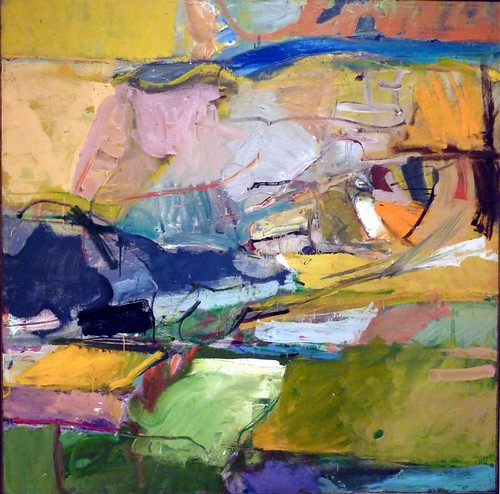
These are the magical "Berkeley Series" named in numbers (22, 38, 44 etc). Colors and even forms are allow--freed--to portray their own coherence and coalesce in a vibrant balance. Shapes abstracted from traditional landscape, hills, fields, blue ocean, deep horizon but to cohere into a painting is the artist's responsibility, desire. A figure against the ground--this is landscape: colors of machinery and civilization against rural cultivation (see Kiran Chandra's "This Place, That Place") and nature--gray burn iron white stiff red fluttering cream purple hint of flesh, lines of roads, paths, fence boundary...themselves borders of the canvas
Subscribe to:
Posts (Atom)